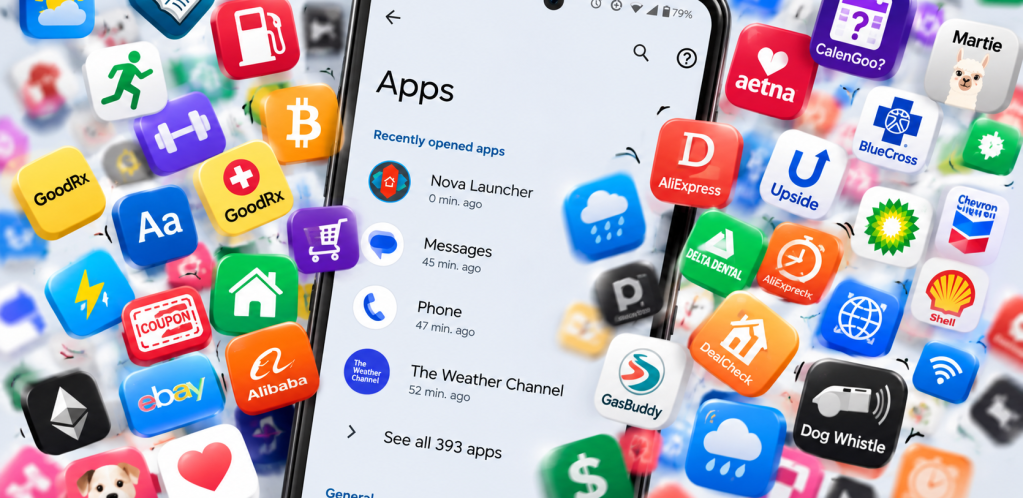
Full disclosure: I have 393 apps on my phone. I use maybe twenty.
I’m not proud of it—I have been called insane—but it does establish my credentials for what I’m about to say: I may have been patient zero for there must be an app for that.
I have an app for every gas station, plus GasBuddy and Upside, because apparently buying gasoline requires a diversified portfolio. I have three dictionary apps and four weather apps, which seems especially ridiculous considering I live in Florida, where all four can confidently predict sunshine while rain is actively hitting me in the face.
There are six fitness apps, although 8fit was recently bought out, so I can finally delete that one.
Not really bummed I have to stop using it.
I never truly started.
I have GoodRx. I don’t take any medication.
I still have the app for Blue Cross, even though the company switched to Aetna. I have Aetna too. There are four cryptocurrency apps despite the fact that I haven’t bought or sold crypto in years.
But I might again.
Maybe.
“Maybe” has become sufficient reason for applications to continue occupying space on my phone indefinitely.
Then there are the apps whose origins have been completely lost to history.
I have something called CalenGoo.
I don’t know what CalenGoo does. I don’t remember downloading CalenGoo. At some point in my life, however, I apparently encountered a problem and decided CalenGoo was the answer.
Whatever that problem was, I hope I’m doing better now.
There’s one called Martie. No idea who he is.
DealCheck. I’m reasonably certain I had a very good reason for that one.
Three coupon apps that rarely seem to have coupons for the fresh food I actually buy.
Alibaba and AliExpress, although every time I open one of them, I have to remind myself why those are two different things.
And a dog-whistle app.
That one I use.
Just not for the dog. I don’t have a dog.
What I have are three kids.
When they forget themselves in front of their screens too long, I occasionally turn on a frequency they can hear but I can’t.
“Do you hear that?”
No.
No, I do not.
Technology is wonderful.
A Museum of Good Intentions
The strange thing about stopping to actually scroll through nearly 400 apps is that after a while, instead of seeing software.
I started seeing versions of myself.
There was the version who was going to exercise regularly. She downloaded six apps to prepare.
There’s the version who was going to become an exceptionally informed cryptocurrency investor.
The bargain hunter.
The hyper-informed weather watcher.
The person who apparently needs three dictionaries readily available at all times.
Some apps belong to jobs, insurance plans, interests and circumstances that aren’t part of my life anymore. Others belong to things I thought I would do but didn’t. A few are waiting for the person I might still become.
Our phones have quietly become museums of our intentions.
And I have apparently decided not to throw away any of the exhibits.
Maybe that’s because downloading an app feels deceptively close to being productive.
Download a fitness app and, for approximately seven minutes, you feel like someone who works out.
Download a budgeting app and suddenly your finances feel slightly more responsible, even if you haven’t entered a single transaction.
Download a coupon app and you have technically begun saving money.
Download an organizational app and—
Well, now you have another app to organize.
For years, I loved this.
Have a problem?
There must be an app for that.
And usually there was.
But somewhere along the way, something changed.
I stopped looking for apps.
Apps Started Looking for Me
Well, marketing companies did, anyway.
Want the restaurant discount?
Download the app.
Want to park your car?
Download the app.
Your kid’s school needs to communicate with you?
There’s an app.
Want the rewards price at the gas station?
You know what to do.
Something that once felt like a tiny technological miracle has gradually become another administrative task.
Download the app.
Create an account.
Verify your email.
Create a password with eight characters, one capital letter, one number, one symbol and apparently the lost coordinates of Atlantis.
Would you like to enable notifications?
No.
Would you like to share your location?
No.
Would you like us to track your activity across other apps and websites?
Absolutely not.
Would you like to reconsider?
I just wanted ten cents off a gallon.
The promise of apps was convenience. And many of them are convenient. I am certainly in no position to pretend otherwise. Somewhere among my 393 tiny icons are applications I use constantly and would complain bitterly about losing.
But convenience has developed an interesting habit of assigning us homework.
We scan our own groceries. Manage our own reservations. Schedule our own appointments. Download our own tickets. Troubleshoot our own accounts. Navigate automated menus because speaking to an actual person has become the premium option.
Individually, none of these things is particularly burdensome.
Collectively, they begin to feel like a part-time administrative position nobody remembers applying for.
There Really Is an App for That
I’m not deleting all my apps.
Let’s not get ridiculous.
I’ll probably delete 8fit.
And Blue Cross.
CalenGoo deserves at least one investigation before I evict it. It may have been faithfully performing some essential function for the past few years while I ignored it.
And the crypto apps are staying.
Because I might get back into crypto.
Maybe.
But somewhere between my first delighted discovery that there really was an app for nearly everything and the moment businesses began assuming I should download one for nearly everything, convenience changed.
It stopped simply removing friction from our lives.
Sometimes it just moved the friction onto us.
And maybe that’s why my phone now contains 393 little squares representing things I bought, tried, planned, abandoned, forgot, might do again and apparently once thought required CalenGoo.
There really is an app for everything.
I should know.
I think I have most of them.

