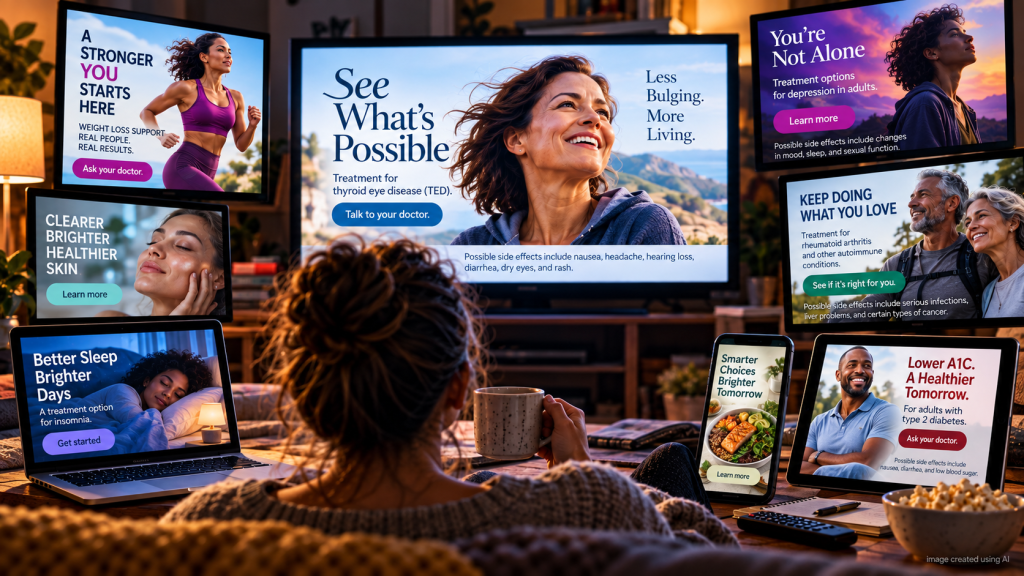
“Mom, you heard that? Fix your eyes, but you might go deaf!” my youngest laughed at the latest ad for treating thyroid eye disease.
Yet another bizarre medication commercial where smiling people enjoy their newly improved lives while a soothing voice runs through a list of potential side effects that makes you wonder what exactly we’re being sold.
Prescription drug advertising has become so commonplace in America that we barely seem to notice how strange it is anymore.
I personally feel absolutely harassed by Ro.
I have no problem with commercials. I don’t pay extra to avoid them. What infuriates me is the sheer number of ads for this drug. Three ads in succession. Every commercial break. Everywhere I go online, I’m inundated with ads for this weight-loss “miracle.”
An athlete.
A comedian.
A couple “doin’ it together!”
A Gen Xer.
A suburban mom.
All healthier on Ro.
When Prescription Drugs Get a Lifestyle Makeover
Fitness apps push “micro-dosing.” Ads make injecting medication look less like medical treatment and more like the latest addition to your fitness routine. Track your steps. Drink your water. Get your protein. Take your shot.
Somewhere along the way, prescription medication got a lifestyle makeover.
And it isn’t just weight-loss medication.
Drugs used to treat chronic and inflammatory conditions are advertised with the same bright, aspirational imagery. Children eat happily. Families gather around tables. People travel, exercise, laugh and reclaim whatever part of ordinary life their condition has interrupted.
I understand the appeal. Who wouldn’t want that?
That’s also what makes advertising so effective. They’re not really selling us medication. They’re selling us the life we’re supposed to imagine medication will give us.
Then there are the commercials for depression medications, followed by medications designed to enhance the effects of those medications, followed by still more medications to manage their side effects.
A medication for your medication for your medication.
Are We Being Educated—or Conditioned to Shop for Prescriptions?
At some point, you have to wonder: Are we being educated about treatment options, or are we being conditioned to shop for prescriptions?
That question becomes even more uncomfortable when the medications being advertised treat conditions that can affect mood, perception or cognition. What responsibility comes with marketing directly to those patients? And should medications carrying potentially serious side effects be sold to us using the same bright imagery, catchy music and carefully selected faces—the same techniques used to sell us cereal?
I’m not questioning whether these medications help people. I’m questioning why they need to be sold so heavily to us.
Three Out of Four American Adults
According to the CDC, three out of every four American adults live with at least one chronic condition. More than half live with two or more.
That is staggering.
It also means there is an enormous audience of people looking for relief, looking to feel better, looking to get some part of their lives back.
They are marketed to relentlessly.
And the part I can’t reconcile: the medication isn’t the only thing we’re being sold.
Athletes and entertainers sell us alcohol, fast food, sugary drinks, gambling and whatever else has paid enough to borrow their faces. Our screens sell us convenience at every turn. Sit down. Order in. Have it delivered. Scroll a little longer.
Then another familiar face appears to sell us wellness.
A comedian. An athlete. A suburban mom.
Take the shot. Ask your doctor. Start your journey.
I’m not suggesting that one commercial causes an illness or that every health problem can be prevented by eating better and exercising. Life and health aren’t that simple.
I’m asking why we accept the contradiction so easily.
When Do Consumers Fight Back?
Why are we comfortable being marketed to when we’re healthy, marketed to when we’re sick, and marketed to while we’re trying to get healthy again?
When do we, the consumers and the patients, fight back?
Not against medicine. Not against the people who need it. Against the idea that we should unquestioningly consume whatever is placed in front of us simply because the person selling it looks familiar, healthy, happy or trustworthy.
At what point do we stop being patients who consume and become customers who question what we’re being sold?
My youngest was laughing when she said, “Fix your eyes, lose your hearing.” But she was also listening.
Really listening.

